

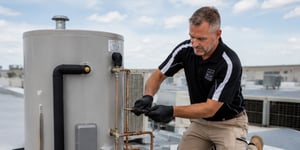
Hot Water System Replacement Planning for Commercial Sites
- Plan before failure to allow time to assess options, budget and minimise operational disruption.
- Consider condition, not just age. Recurring faults, rising repair costs and declining performance can indicate it is time to replace.
- Compare your options. Electric, heat pump, gas, solar-assisted and hybrid systems have different benefits and site requirements.
- Assess the whole site, including demand, infrastructure, plant space and shutdown requirements.
- Check rebates early, as eligibility should be confirmed before purchasing equipment or commencing work.
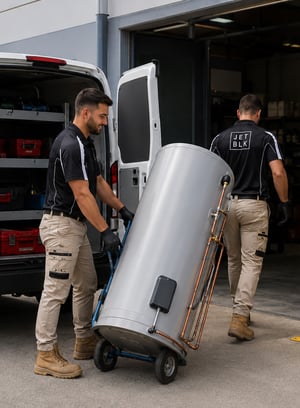
When should you start planning a replacement?
Consider a condition assessment when you notice:
- Recurring leaks, breakdowns or temperature issues
- Slow recovery or insufficient hot water
- Corrosion or unusual equipment noise
- Increasing repair or energy costs
- Parts becoming difficult to source
- Changes in occupancy or site demand
- Concerns about how a failure would affect operations
Age alone does not determine whether replacement is required. Equipment condition, performance, maintenance history and the operational impact of failure should also be reviewed.
Should you repair or replace the system?
Repair may remain practical when the fault is isolated, parts are readily available and the wider system is in sound condition.
Replacement should be considered when faults are recurring, multiple components are deteriorating, performance no longer meets demand or repairs are no longer improving reliability.
Compare:
- The cost and expected life of another repair
- The condition of the wider system
- Recent and projected repair costs
- Current energy use
- Equipment and parts availability
- Replacement cost and expected service life
- The operational cost of an unexpected failure
What commercial hot water options are available?
| SYSTEM | POTENTIAL ADVANTAGES | KEY CONSIDERATIONS | MAY SUIT |
|---|---|---|---|
| Electric storage | Familiar, relatively simple and no on-site gas combustion | Electrical capacity, energy use, storage losses and recovery time | Smaller amenities and stable demand |
| Heat pump | Energy efficient, supports electrification and can integrate with solar PV | Capital cost, airflow, noise, condensate, storage and recovery rate | Planned upgrades with regular demand |
| Gas continuous flow | Compact, responsive and modular | Gas strategy, flow capacity, flueing and maintenance of multiple units | Variable or extended demand |
| Gas storage | Strong recovery and stored capacity | Gas use, storage loss, corrosion and future electrification plans | Existing gas-served plant rooms |
| Solar-assisted | Renewable-energy contribution and reduced purchased energy | Roof suitability, booster source and system complexity | Sites with regular demand and solar access |
| Hybrid or staged | Flexibility, redundancy and staged investment | Controls, plant space and maintenance complexity | Critical sites or gradual electrification |
A like-for-like replacement may be appropriate, but the existing system should not automatically determine the new technology or capacity.
What should you assess before choosing a system?
Demand
Review daily consumption, peak usage, required temperatures, fixture numbers, recovery time, operating hours and future occupancy.
Infrastructure
Confirm electrical and gas capacity, pipework condition, plant space, ventilation, drainage, access and any structural or switchboard upgrades.
Operational risk
Consider how long the facility can operate without hot water, which services would be affected and whether temporary supply, after-hours work, staging or redundancy is required.
Lifecycle cost
Compare equipment, installation, infrastructure upgrades, energy use, maintenance, replacement parts, service life and the financial impact of failure—not only the purchase price.
Organisational objectives
Consider electrification, emissions targets, existing or planned solar PV, future property plans and the expected life of the new equipment.
What should a hot water condition assessment include?
A useful assessment should record:
- Existing equipment, age and condition
- Current faults and maintenance history
- Pumps, valves, controls and pipework condition
- Current and future demand
- Immediate and emerging risks
- Repair, upgrade and replacement options
- Priorities and indicative timeframes
- Access and installation constraints
- Shutdown or temporary-supply requirements
- Recommended next steps
The outcome should identify what requires immediate action, what can be monitored and what should be included in future capital planning.
Are rebates available for commercial hot water replacement?
Eligible heat-pump, solar and high-efficiency electric systems may attract certificates, rebates or funding.
Eligibility depends on the location, customer and property type, existing equipment, proposed model, installation configuration and scheme rules.
Confirm eligibility before purchasing equipment, signing a contract or commencing work.
The following information was checked on 5 August 2026.
Current rebates and incentive pathways
| Location | Potential support | What customers should know |
|---|---|---|
| Australia-wide | Small-scale Technology Certificates | Eligible solar and air-source heat-pump water heaters may create STCs. The value is not fixed and depends on the approved model, postcode and installation date. |
| NSW | Energy Savings Scheme | Eligible commercial heat-pump water heater installations and upgrades may generate Energy Savings Certificates (ESCs), helping reduce project costs. Eligibility and certificate values depend on the installation type, approved equipment and scheme requirements. |
| Victoria | Victorian Energy Upgrades | Eligible commercial and industrial heat-pump water heater installations may generate Victorian Energy Efficiency Certificates (VEECs), helping offset project costs. Eligibility and certificate values depend on the installation type, approved equipment and scheme requirements. |
| Queensland | Community Housing Energy Upgrades | Eligible registered community-housing providers may receive up to $4,500 excluding GST per eligible dwelling. This is not a general business rebate. |
| South Australia | Retailer Energy Productivity Scheme | Participating retailers and activity providers may offer support for eligible business energy-productivity activities. Availability varies. |
| ACT | Commercial Landlords Pilot | Eligible commercial landlords may receive up to $50,000, covering up to 75% of eligible costs, to replace centralised gas equipment with efficient electric systems. |
| WA, Tasmania and NT | National STCs and periodic grants | No broad local commercial hot water rebate was identified. Industry, local-government or periodic business grants may still apply. |
National Small-scale Technology Certificates
STCs may apply to eligible solar water heaters and air-source heat-pump systems at commercial properties.
Certificate quantity depends on:
- Approved make and model
- Installation postcode and date
- Applicable deeming period
- Calculated renewable-energy contribution
The 2026 deeming period is five years and reduces annually until the scheme ends in 2030.
- Estimate STCs using the official calculator
- Review STC calculation guidance
- Search eligible solar and heat-pump products
A product being marketed as a heat pump does not automatically make it eligible. Check the exact model before proceeding.
New South Wales
The NSW Energy Savings Scheme supports eligible business energy-efficiency projects through Energy Savings Certificates.
Commercial projects should be assessed by an Accredited Certificate Provider before work begins. The household hot water incentive should not be presented as a general commercial rebate.
The 2025 NSW Heat Pump Feasibility Grant is closed. Customers considering larger projects can monitor NSW business decarbonisation programs for future funding rounds.
Victoria
Commercial and industrial heat-pump water-heater projects may qualify under Victorian Energy Upgrades when approved equipment and accredited providers are used.
The benefit depends on the certificates generated and the provider’s commercial arrangement.
- Victorian Energy Upgrades for businesses
- Commercial and Industrial Heat Pump Activity Guide
- VEU registers and calculator
- Find an accredited provider
Queensland
Queensland’s current hot water support is limited to eligible registered community-housing providers.
The Queensland Community Housing Energy Upgrades program includes eligible heat-pump and solar hot water systems, including common systems serving multiple dwellings.
Applications are scheduled to close on 30 October 2026, with installations completed by 30 June 2027. Conditional approval is required before purchasing or installing equipment.
South Australia
South Australia’s Retailer Energy Productivity Scheme supports eligible household and business energy-productivity activities.
Offers vary between participating retailers and providers, so customers should confirm current availability before including an incentive in the project budget.
Australian Capital Territory
The ACT Commercial Landlords Pilot supports eligible low-rise commercial properties replacing centralised gas heating or hot water with efficient electric systems.
Eligible buildings generally require at least four commercial tenants and no more than two floors. Funding is limited and subject to assessment.
Other states and territories
Customers in Western Australia, Tasmania and the Northern Territory may still qualify for national STCs or periodic industry and business grants.
Useful planning tools
Commercial Heat Pump Estimator
The Australian Alliance for Energy Productivity’s free calculator provides early estimates for commercial and industrial heat-pump projects, including capacity, energy use, costs, emissions, space and potential certificates.
Use the Commercial Heat Pump Estimator
It supports early planning but does not replace site inspection, demand analysis or detailed design.
STC calculator
Use the official calculator to estimate certificates for an eligible solar or heat-pump water heater.
You will need the system brand, model, installation date and postcode.
Grants finder
Search current programs by location, industry and business type.
Search Australian business grants
Can multiple incentives apply?
Potentially, but customers should not assume that schemes can be combined.
Before work begins, confirm:
- The product, site and customer are eligible
- The existing equipment meets replacement requirements
- The installer and certificate provider are authorised
- Pre-approval has been received
- Required evidence will be collected
- Multiple incentives can be combined
- The expected benefit is documented in writing
Final eligibility and value are determined by the scheme administrator, accredited provider or funding body.
Commercial hot water planning checklist
Before approving a replacement, confirm:
- Existing equipment and repair history have been reviewed
- Current, peak and future demand has been assessed
- Electrical, gas and hydraulic capacity has been confirmed
- Replacement technologies have been compared
- Capital, energy and maintenance costs have been considered
- Plant space, access, ventilation and drainage are suitable
- Shutdown, staging and temporary supply have been planned
- Equipment lead times are understood
- Compliance, testing and commissioning are included
- Rebates and certificates have been checked before work begins
- Asset records, manuals and warranties will be updated
How can JetBlack Plumbers assist?
JetBlack Plumbers supports commercial and multi-site facilities with:
- Hot water system inspections and condition assessments
- Preventative maintenance and fault diagnosis
- Repair, upgrade and replacement planning
- Electric, gas, heat-pump and hybrid solutions
- Pumps, valves, controls and associated pipework
- Thermostatic mixing valves and backflow prevention
- Temporary hot water and shutdown planning
- Asset lifecycle reporting
- Coordination of associated electrical works
- Identification of potential rebate and certificate pathways
Plan the replacement before failure limits your options
If your hot water system is ageing, unreliable or requiring repeated repairs, another short-term fix may not address the wider risk.
Book a commercial hot water condition assessment with JetBlack Plumbers. We will assess the existing system, identify immediate and emerging risks, and outline practical repair, upgrade or replacement options for your site.
Where relevant, we can also identify the rebate and certificate pathways that should be investigated before work begins.

Hot Water System Replacement Planning for Commercial Sites
Commercial hot water replacement is easier to manage when planned before an ageing system fails. A condition assessment can help determine whether further repairs are worthwhile and identify suitable replacement options while considering demand, infrastructure, lifecycle costs and operational risks.
The right solution will vary by facility, from like-for-like replacement to heat pump, electric, gas, solar-assisted or hybrid systems. Rebates and certificate opportunities should also be investigated early, as eligibility may need to be confirmed before work begins.
JetBlack Plumbers can assess your existing system, identify immediate and emerging risks, and recommend practical repair, upgrade or replacement options—helping reduce the risk of unexpected hot water failure and operational disruption.
Don’t wait for your hot water system to fail.
Book a commercial hot water assessment with JetBlack Plumbers to understand your system’s condition, risks and replacement options.

Australia’s most TRUSTED plumbing contracts and projects PARTNER. We provide a peace of mind partnership through compliance, delivered with INTEGRITY and CARE.